Obligations and specifics of the EPR scheme for mineral and synthetic oils

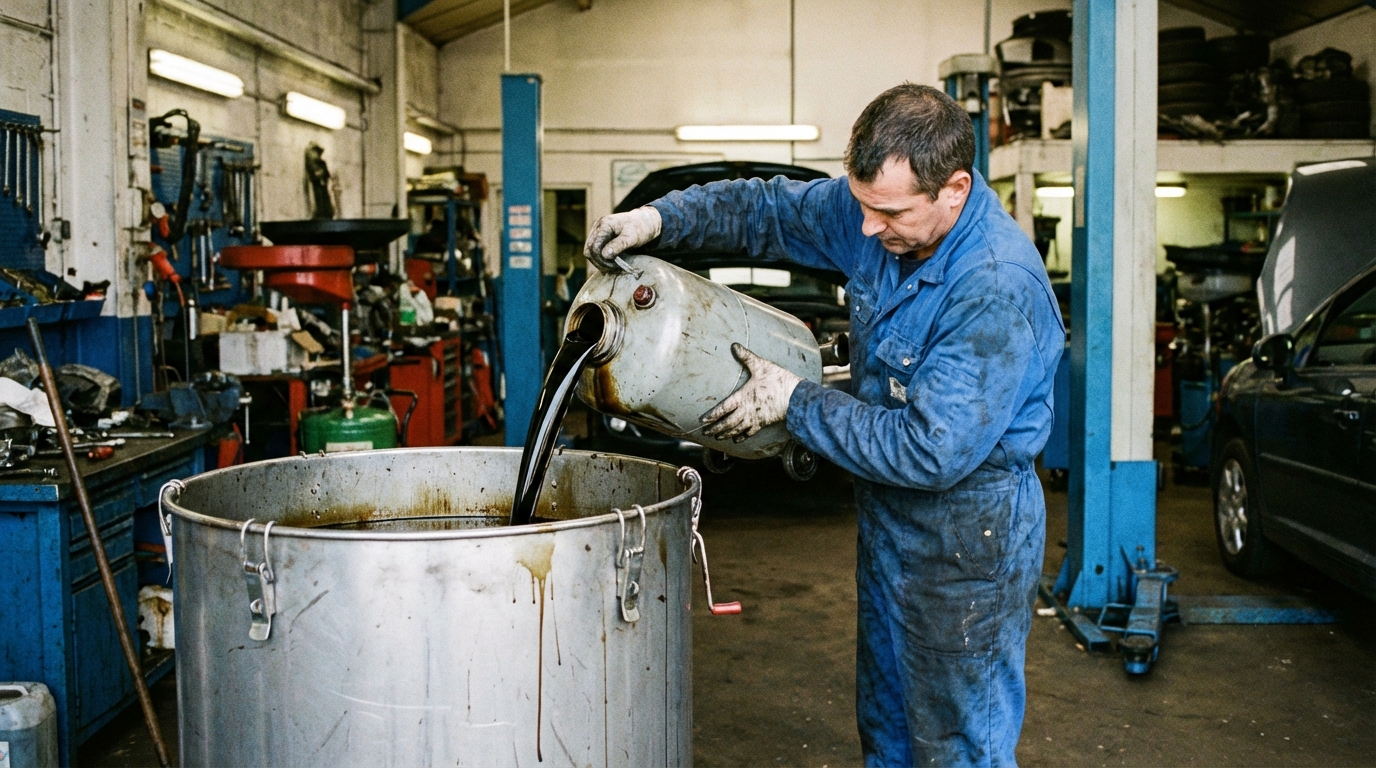
The EPR scheme dedicated to mineral and synthetic oils is one of the most specific environmental schemes in France. Introduced by the AGEC law and operational since 1 January 2022, it requires producers to fund the collection and regeneration of several hundred thousand tonnes of used oils every year.
Whether garages, industrial companies or online sellers, all businesses now need to understand this restricted but tightly controlled scope, based on free take-back for professional holders and priority given to regeneration.
EPR for mineral and synthetic oils: a special case.
Reading time: ~10 min
1. EPR for mineral and synthetic oils: framework and scope
2. Why this EPR scheme is a special case
5. Technical differences and impact on the EPR scheme
6. What this means for online sellers
EPR for mineral and synthetic oils: framework and scope
European Directive 2008/98/EC on waste was transposed to secure a scheme weakened in 2016 by the fall in oil prices. A decree published at the end of 2021 brought the take-back of used oils into the EPR system, supplemented by new provisions that entered into force in 2024.
• Mineral oils from petroleum refining, used as engine lubricants or industrial oils
• Synthetic oils obtained through chemical synthesis, used to lubricate engines and industrial equipment
These products generate around 239,000 tonnes of used oils per year in France, mainly from the automotive sector and industry. Every producer must fund the end of life of these oils through an eco-contribution paid to an authorised producer responsibility organisation (PRO).
Why this EPR scheme is a special case
Before 2022, a collection organisation had already existed since the late 1990s, but it remained dependent on economic conditions. The EPR framework consolidates the scheme legally and financially to secure clear targets.
• Free take-back of used oils for professional holders, provided storage is adequate and oils are not mixed
• Priority given to regeneration to produce new base oils rather than simple energy recovery
• Stronger traceability, with strict reporting obligations for producers and PROs
This combination of a restricted scope, free take-back and priority given to regeneration makes the EPR scheme for mineral oils a concrete example of circular economy applied to a potentially highly polluting stream.
Summary of the specifics
A unique scope
What this means: if you sell engine, transmission, hydraulic or industrial oils, you are concerned, even from abroad.
Free collection
What this means: producers fund, through the eco-contribution, the free take-back of used oils held by professionals.
A recent scheme with a solid track record
What this means: the regulatory framework keeps evolving ("mixed" model in 2025), which requires continuous adaptation.

Traceability and non-mixing
What this means: correct storage and sorting determine the quality of regeneration and the costs borne by producers.
Obligations for producers
Producers include: manufacturers, importers, distributors and online sellers delivering to French customers.
Main obligations: registration with a PRO (for example CompliancR), declaration of tonnages, payment of the eco-contribution and compliance with collection/regeneration targets. Since 2025, the "mixed" model allows the PRO to directly manage part of the collection.
For online sellers, these requirements come on top of other EPR schemes, which is why centralised solutions such as the CompliancR platform are useful: they automate product identification, calculate eco-contributions and prepare declarations. You can also find out how to automate EPR compliance with dedicated tools.
Technical differences and impact on the EPR scheme
Mineral oils: derived from petroleum, cost effective, frequent oil changes (≈5,000 to 7,500 km), meaning a larger flow of used oils.
Synthetic oils: produced by synthesis, better thermal stability, less frequent oil changes (≈10,000 to 15,000 km), but additives that are more complex to regenerate.
Mixing the two types is not recommended: it reduces performance and complicates regeneration. This is why storage must be leak proof and the two types must not be mixed, as required by regulation.
What this means for online sellers
Selling oils, or products containing them, to French customers means: registering with a PRO, obtaining an EPR unique identification number (UIN), structuring your catalogue data to apply the correct fee scale, and tracking annual updates. French marketplaces increasingly require this identifier.
CompliancR, as an authorised EPR representative, centralises these steps, analyses barcodes, applies updated fee scales and provides a single dashboard, useful ahead of the upcoming European regulation that will strengthen traceability.
Frequently asked questions
Are small online sellers concerned? Yes, there is no exemption based on company size or turnover.
I only sell machines that contain oil: am I concerned? It depends: if the oil is not meant to be replaced by the end user, another scheme may apply. A detailed analysis of your catalogue is required.
How can I check the accuracy of my declarations if I manage several EPR schemes? Combining multiple fee scales and thresholds makes manual checking risky. An automated solution that continuously recalculates eco-contributions avoids errors. To learn more, see our guide on EPR compliance.

In summary
With its targeted scope, free collection and regeneration requirement, the EPR scheme for mineral oils illustrates the extended environmental responsibility of producers in France. For online sellers already dealing with other EPR schemes, centralised management by an authorised representative such as CompliancR provides secure compliance and a consolidated view of obligations.