Textile EPR communication: Refashion goes on the offensive against ultra fast fashion
Refashion is looking for an agency to carry its mission
Refashion has just announced an agency competition to design and roll out its public communication campaign. With a budget of €500,000, the project aims to promote:
- Textile recycling challenges;
- The role of the EPR scheme;
- The necessary transformation of purchasing practices.
The timing of this campaign is no coincidence. The rise of ultra fast fashion, embodied by platforms such as Shein or Temu, weakens the reuse and recycling economy, even though it is supported by the eco-contributions paid by producers under their EPR obligations.
Le Relais suspends its collections: a warning signal for the scheme
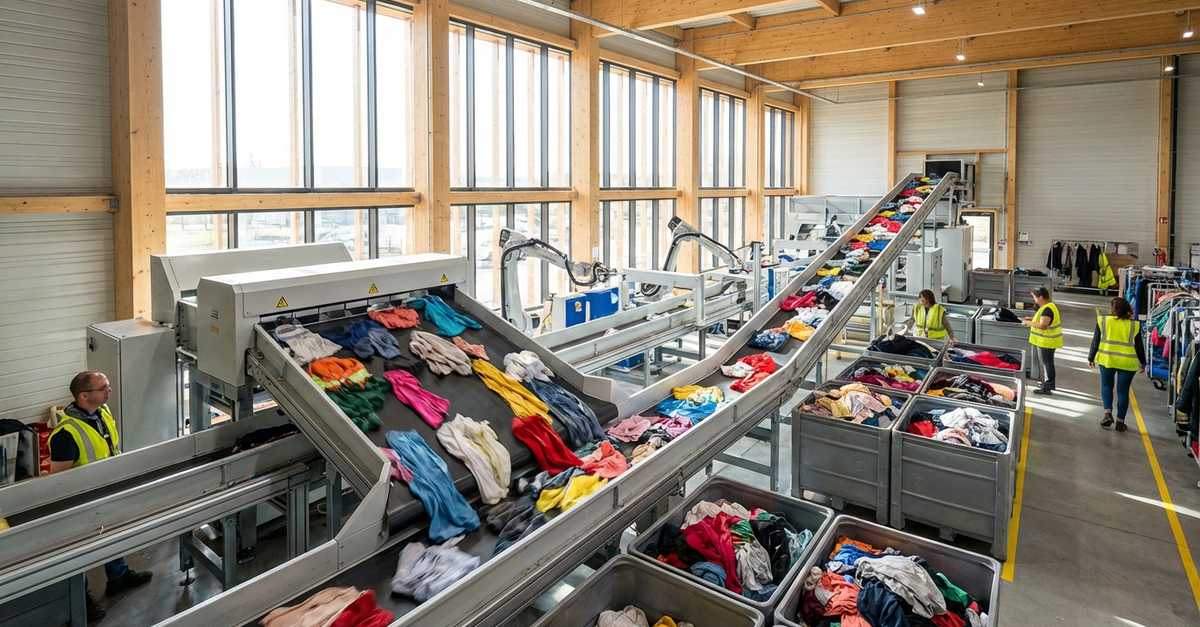
Faced with funding it considers insufficient from Refashion, the producer responsibility organisation (PRO), the Le Relais network, a longstanding social operator in textile sorting, has announced the temporary suspension of its collections from 15 July 2025. This abrupt halt is not just a signal, it is a serious warning about the economic breakdown of the EPR model.
Le Relais, a longstanding operator in textile reuse, is suspending its collections in several regions. With insufficient outlets, no viable economic models and a lack of structural support for collection, the association can no longer maintain its activity in some areas.
Today, the actual cost of sorting reaches €304 per tonne, but Refashion only pays back €156, barely half the expenses incurred. A year after a first increase (from €125 to €156/t), complaints have had no effect. Le Relais warns that more than 3,000 jobs are at risk, many of them in the social and solidarity economy.
In response, the government has announced emergency funding to support the scheme at €223/t in 2025, then €228/t in 2026, financed exclusively by Refashion's eco-contribution funds.

This conflict reveals a paradox: consumers pay, brands fund, but it is the ground-level operators who are cracking, for lack of a viable economic model. If the EPR model were to lose its key players, all textile recycling ambitions would be at risk.
This withdrawal is a tangible marker of the crisis facing the Textile, Household Linen and Footwear (TLC) EPR scheme: these are no longer just weak signals, but actual closures, with immediate social and environmental consequences.
In a context where producers must justify the traceability and recovery of their volumes, the weakening of ground-level operators, particularly those in the social and solidarity economy, undermines the credibility of the entire EPR chain. It is now urgent to rebuild an economically sustainable model, where collection is no longer the weak link, but the pillar of circular transformation.
Each year, around 270,000 tonnes of textile waste are collected in France, and 60% of sorted products are resold second-hand, 90% of which abroad, according to Refashion's 2023 report.
Ultra fast fashion: the great absentee from EPR?
Many stakeholders now denounce a double standard:
- On one side, established brands are subject to strict requirements: EPR registration, eco-contributions, modulations, traceability.
- On the other, some international sellers take advantage of customs thresholds or regulatory grey areas to bypass their obligations.
The result: an unbalanced system, where those who play by the rules of EPR compliance also pay for those who do not.
In response, Refashion wants to put the eco-contribution back at the heart of the relationship between brands, consumers and public bodies.
Textile EPR: a matter of compliance, but also consistency
For textile brands operating in France, EPR compliance is no longer a mere formality:
- Checks by ADEME (the French environment agency) are increasing;
- Environmental labelling is being prepared;
- Pressure from NGOs and consumers is rising.
Refusing to comply with EPR now means taking a regulatory, economic and reputational risk. Conversely, compliant brands can claim a clear position, aligned with environmental expectations and values of transparency.
CompliancR: your compliance partner to face fast fashion
At CompliancR, we help textile brands and e-commerce sellers achieve compliance with the TLC EPR scheme. Our platform lets you:
- Identify products subject to EPR, including in complex catalogues;
- Automatically calculate and modulate your eco-contributions;
- Manage your multichannel obligations (e-commerce site, marketplaces, points of sale);
- Justify your compliance at any time, to ADEME or your partners.
In a disrupted textile sector, compliance becomes a marker of seriousness.
CompliancR helps you take a stand: for traceability, for sustainability, and against unchecked fast fashion.